
Athletics, the premier Olympic sport, has grappled with complex cases of athletes with differences in sexual development (DSD) for nearly a century, making it a trailblazer in legislating the boundaries of the female category.
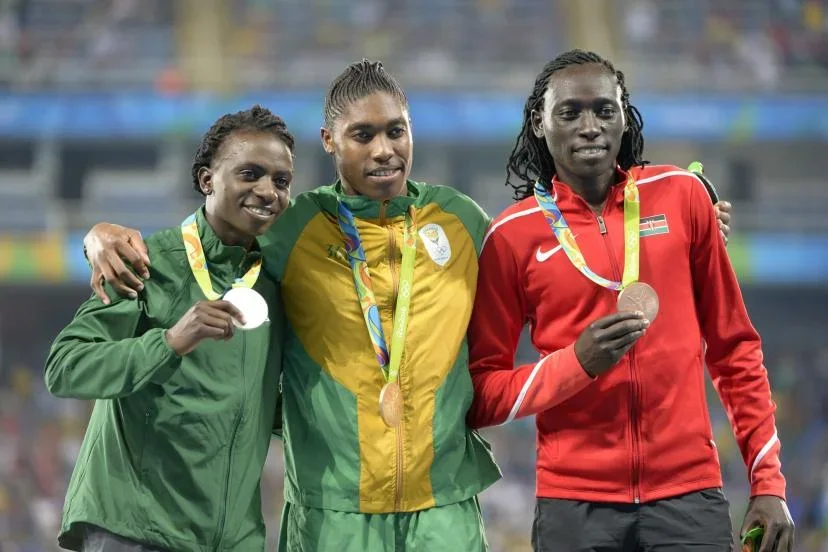
From left to right, Francine Niyonsaba, Caster Semenya, and Margaret Wambui, the three medalists in the 800m at the 2016 Rio Olympics. (Bob Thomas/Popperfoto via Getty Images)
Their names are far less known than Caster Semenya’s, but they endured similar struggles. In 2019, during a series in L’Équipe on “sexual identity in athletics history,” we traveled to Étain (Meuse) to interview Dominique Caurla. Her father, Léon, had been an international French sprinter under the birth name “Léa.”
“My father was born with testicles and a penis retracted inside,” Dominique Caurla explained modestly at the time, speaking of her father, who had intersex traits. “For my grandfather, he was a girl, so he declared him as such and raised him as a girl.”
Léa Caurla notably won a bronze medal in the 200m at the 1946 European Championships in Oslo before ending her career on the eve of the 1948 London Olympics, refusing to undergo a medical examination that served as a disguised gender verification test.
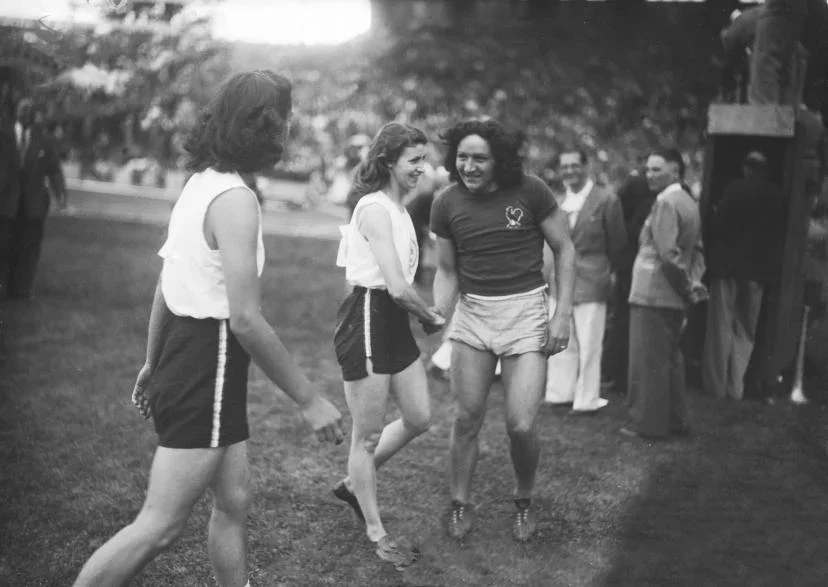
Léa Caurla (right) in 1947. (Jacques Normand/L’Équipe)
At that time, what could be called “gender verification tests” resembled a gynecological exam but lacked regulation. The International Athletics Federation made it mandatory in 1966 for participation in the Budapest European Championships. Polish sprinter Ewa Klobukowska passed this test and received her “femininity certificate.” Yet, years later, the Olympic 4x100m relay champion from Tokyo 1964 became the first athlete in history to fail a gender verification test.
Increasingly stringent tests since 2011
Ahead of the 1968 Mexico City Olympics, the International Olympic Committee (IOC) introduced a new test (the Barr body test). Klobukowska was found to have a genetic anomaly, and an expert committee concluded she had “insufficient femininity.” She was banned for life, her records erased, until she was rehabilitated in the late 1990s when such tests were banned (until last year). In fact, anti-doping efforts with urine tests—where the controller sees the athlete’s sex during urination—long served as disguised gender checks. It was the emergence of Caster Semenya at the highest level in 2009 that brought these issues back into the spotlight.
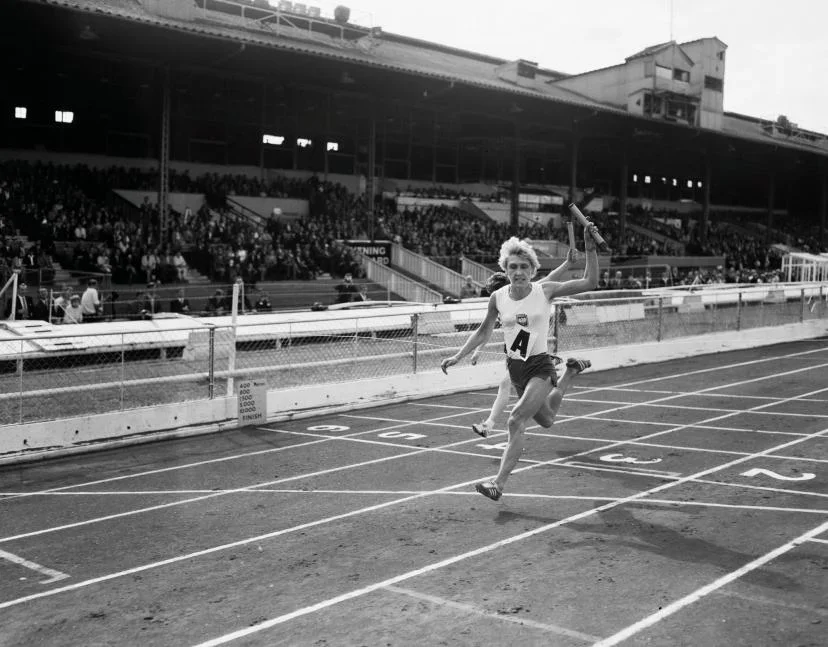
Polish Ewa Klobukowska, suspended in 1968 due to a genetic anomaly, later rehabilitated in the 1990s. (Roger Jackson/Central Press/Hulton Archive/Getty Images)
The 18-year-old South African burst onto the global stage by dominating the 800m at the Berlin World Championships. Deviating from the outdated beauty standards imposed on female athletes, she was immediately suspected of being a man. The controversy escalated, and the IAAF tried to douse the flames, stating that tests to verify her femininity were underway. The answer was yes: Caster Semenya is a woman. A woman who “naturally produces high levels of testosterone, with an XY karyotype.”
Athletics: Caster Semenya vs IAAF: Ten years of controversy (4 minutes)
That might have ended it, but the international federation pushed further. “The IAAF became the first federation to approve new rules governing the eligibility of women with hyperandrogenism to compete in women’s events,” said a statement in April 2011. This sparked a widespread conundrum. Athletes with differences in sexual development (DSD) were required to maintain testosterone levels below 10 nmol/L to compete.
The Court of Arbitration for Sport deemed the IAAF’s regulations invalid in 2015
Semenya complied, as did others, and her trophy case expanded (world champion in 2013 and 2017, Olympic champion in 2012—after Russian Mariya Savinova’s disqualification—and 2016), all amid legal battles. Meanwhile, Indian sprinter Dutee Chand, banned for naturally high testosterone, took her case to the Court of Arbitration for Sport (CAS). In July 2015, CAS suspended the IAAF’s regulations, demanding proof of a link between testosterone levels and athletic performance.
This was only a temporary setback. In 2018, the federation refined its rules, requiring hyperandrogenic athletes to lower testosterone below 5 nmol/L for distances from 400m to one mile (1,607m). Many saw this as an anti-Semenya measure. The 2016 Rio Olympics 800m final, with a podium of three DSD athletes (Semenya, Francine Niyonsaba, and Margaret Wambui), undoubtedly fueled this insistence.

Athletics, 2028 Olympics: Sebastian Coe welcomes the IOC’s reinstatement of gender verification tests
British athlete Lynsey Sharp, sixth in that Rio final and author of a thesis on hyperandrogenism, admitted: “I tried to push the issue aside all year, but we all know how each of us feels. It’s beyond our control; we rely on our leaders and their ability to get us out of this.”
World Athletics (formerly IAAF) tightened the screws further in 2023, outright banning transgender athletes (who had undergone male puberty) from competition and reducing the testosterone threshold for DSD athletes to 2.5 nmol/L.
“That makes no sense,” Semenya told us after the announcement. “I am totally against these rules. Sport has never been fair and never will be. If it were, we’d all be the same without any differences. Fundamentally, it’s simple: there are men and women. But this institution wanted to categorize women with differences.”
Mandatory gender verification tests return in 2025
In 2025, World Athletics, whose president Sebastian Coe boasts of being a pioneer in “protecting the female category,” once again led the charge by reinstating mandatory gender verification tests. To compete in the recent Tokyo World Championships, women worldwide had to undergo an SRY genetic test (revealing the presence of the Y chromosome, an indicator of biological sex, though studies show biological sex isn’t defined by a single marker).
2028 Olympics, Gender Verification Tests: IOC reinstates tests; Caster Semenya decries “disrespect toward women”
“I’m a bit torn,” admitted 800m specialist Rénelle Lamote. “I know it’s hard to find fairness in sport. Being tested is uncomfortable. And if I were a man, what then? These are the rules. I respect them. But it does make me think of athletes who suffered in the past. You immediately feel a bit suspect.”
As if it were a game, athletes are informed of their SRY test results via a somewhat cynical email. If the Y chromosome is not found, a smiling emoji appears with the message “verification complete.” A childish response to a far more complex issue.
Caster Semenya
Also read:
– Athletics, Health: Jakob Ingebrigtsen: “When I’m ready to run, I’ll take risks” (4 min)
– Athletics, Marathon: Sawe: “My life has already changed” (3 min)
– Athletics, Editorial: Sawe under 2 hours: an achievement met without fanfare (2 min)