Psychologist Matthew Lieberman explained last week in an interview with La Vanguardia that humans, despite priding themselves on being independent and free from external influence, are “exquisitely sensitive to how others see us.” He gave two examples: “If your parents believe you’re good at math, you’ll end up believing it too. And if your friends think you’re a terrible dancer, you’ll accept that as well.”
Reading that, I immediately thought of Espanyol. But I often find myself crunching numbers—never have three matchdays and nine points meant so much inside my mind—or trying to make sense of the team’s second-half collapse. I pushed the thought aside, afraid of turning it into an obsession.
However, with the appointment of Monchi as the club’s sporting director on Monday—without knowing whether the team will end up in the top flight or the second division, and without knowing whether his contract includes a relegation release clause (imagine that, Bielsa-style but on a much larger scale)—the idea resurfaced: “We are exquisitely sensitive to how others see us.” Eureka!
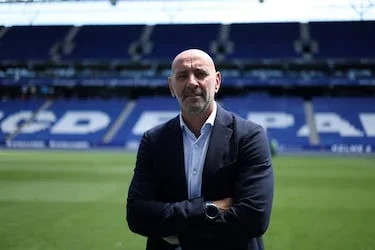
Monchi, on Monday, on the green of the RCDE Stadium.
What Lieberman was referring to, and what directly links to Espanyol’s current crossroads, is nothing other than the Pygmalion effect. Pure psychology and pedagogy, which has even made its way into film and literature, and has been proven in countless experiments: the expectations placed on a person or a group change their performance—for better or worse.
Why did Espanyol reach such heights in the first half of the season? Beyond talent, hard work, and discipline, Manolo González had instilled in them a habit of winning since preseason. But something broke during or after the Christmas period. Why has the winless streak stretched to 18 games? Probably because the squad has come to believe they are worse than they really are. That’s a Golem effect—it has grown like a snowball rolling down a mountain.

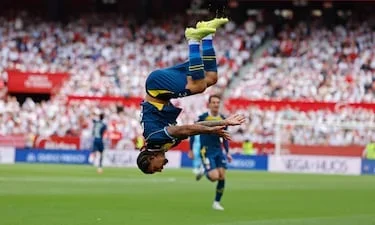
Dolan, celebrating a short-lived 0-1 lead against Sevilla on Saturday with a backflip.
And perhaps it’s just a perception, but the timing of Monchi’s appointment, his first speech focusing more on boosting the players’ self-esteem than on outlining his project or intentions, and the Andalusian’s own tendency to inject ambition into the dressing room, all point directly to a Pygmalion effect.
Another club might have chosen to sack the coach, have the president deliver an emotional speech, or prepare a motivational video for the squad. But Espanyol has opted for Monchi to make the players realize what they are capable of, to guarantee that they will succeed. And that survival—fought as much on a physical and tactical level as on a mental one—ultimately becomes a self-fulfilling prophecy.